

Beyond Note-Taking
Spoken Knowledge, Made Visible.
Support examiners with richer evidence from oral assessments without automating academic judgment or exporting sensitive material.
- FTL role
- AI research, system architecture, local deployment, evaluation and research communication
- Domain
- Universities & Institutions · Science & Simulation
- Format
- Publication · Research system · Assessment workflow
- Credits
- Developed at MUC.DAI, Munich University of Applied Sciences, by Maximilian Dauner, Ricky Liu and Gudrun Socher.
Beyond Note-Taking presentation
Slide 1 of 8


- Slide 1 of 8
- Slide 2 of 8
- Slide 3 of 8
- Slide 4 of 8
- Slide 5 of 8
- Slide 6 of 8
- Slide 7 of 8
- Slide 8 of 8
- 01
Context
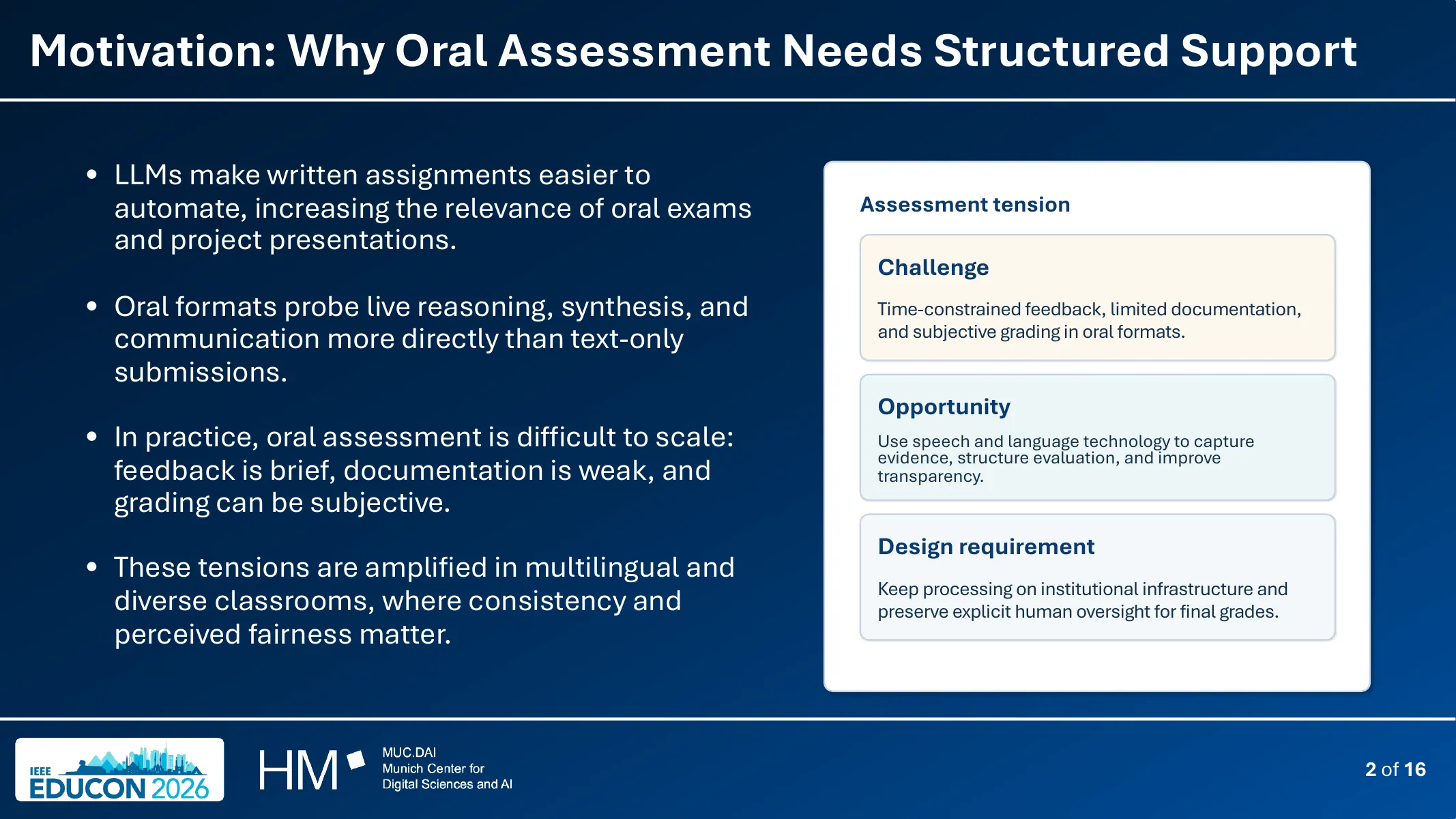
Oral examinations reveal reasoning in real time, yet they are difficult to document consistently and leave little time for detailed feedback.
- 02
Creative vision
Make spoken evidence searchable, traceable and useful while keeping final evaluation exclusively with the examiner.
- 03
Challenge & constraints
Speech processing, institutional knowledge, rubric alignment, uncertainty and local privacy requirements had to operate coherently.
- 04
What was made
Readable examiner reports and structured observations with timestamps, rubric alignment and explicit uncertainty warnings.
- 05
What was built
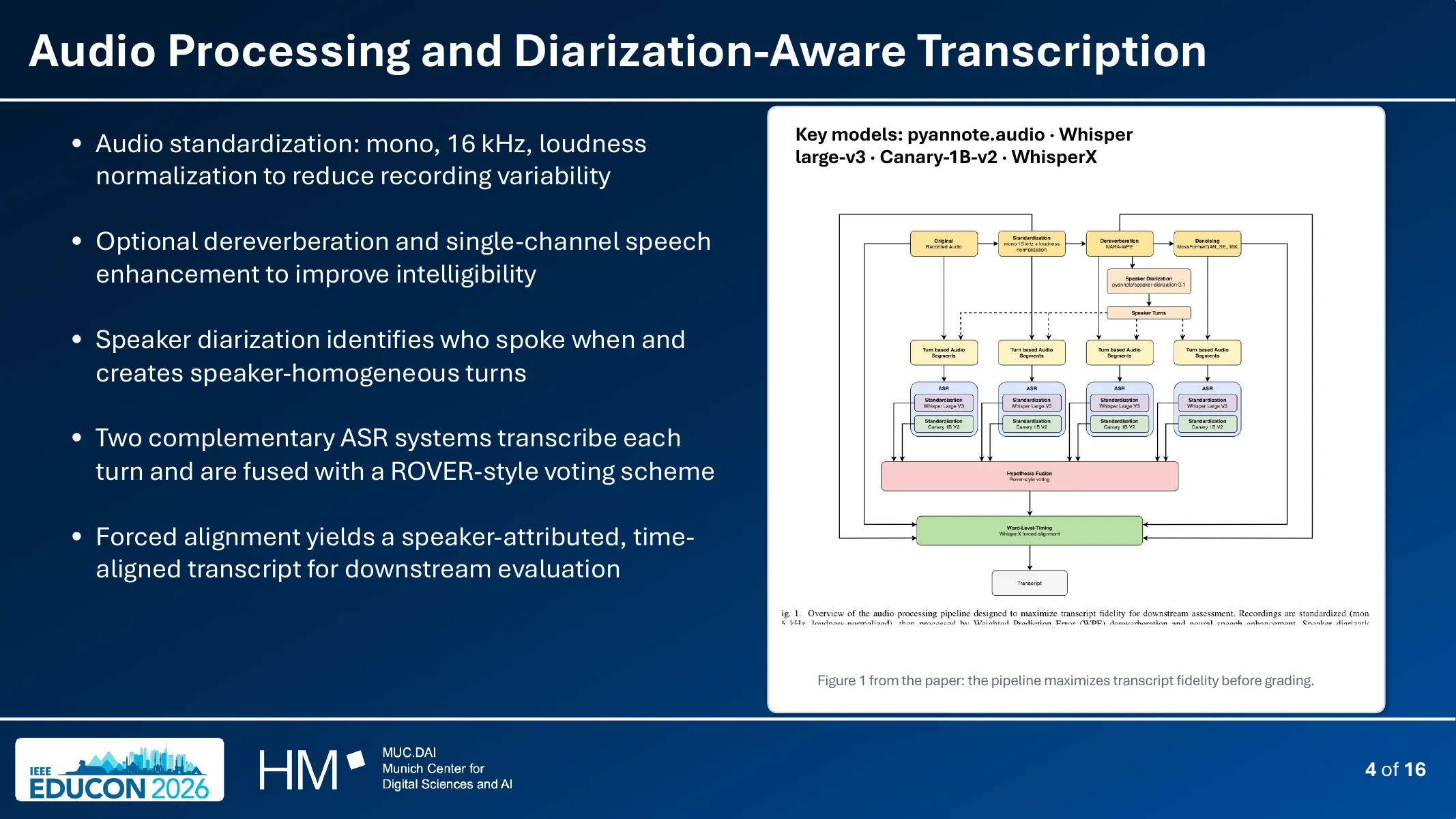
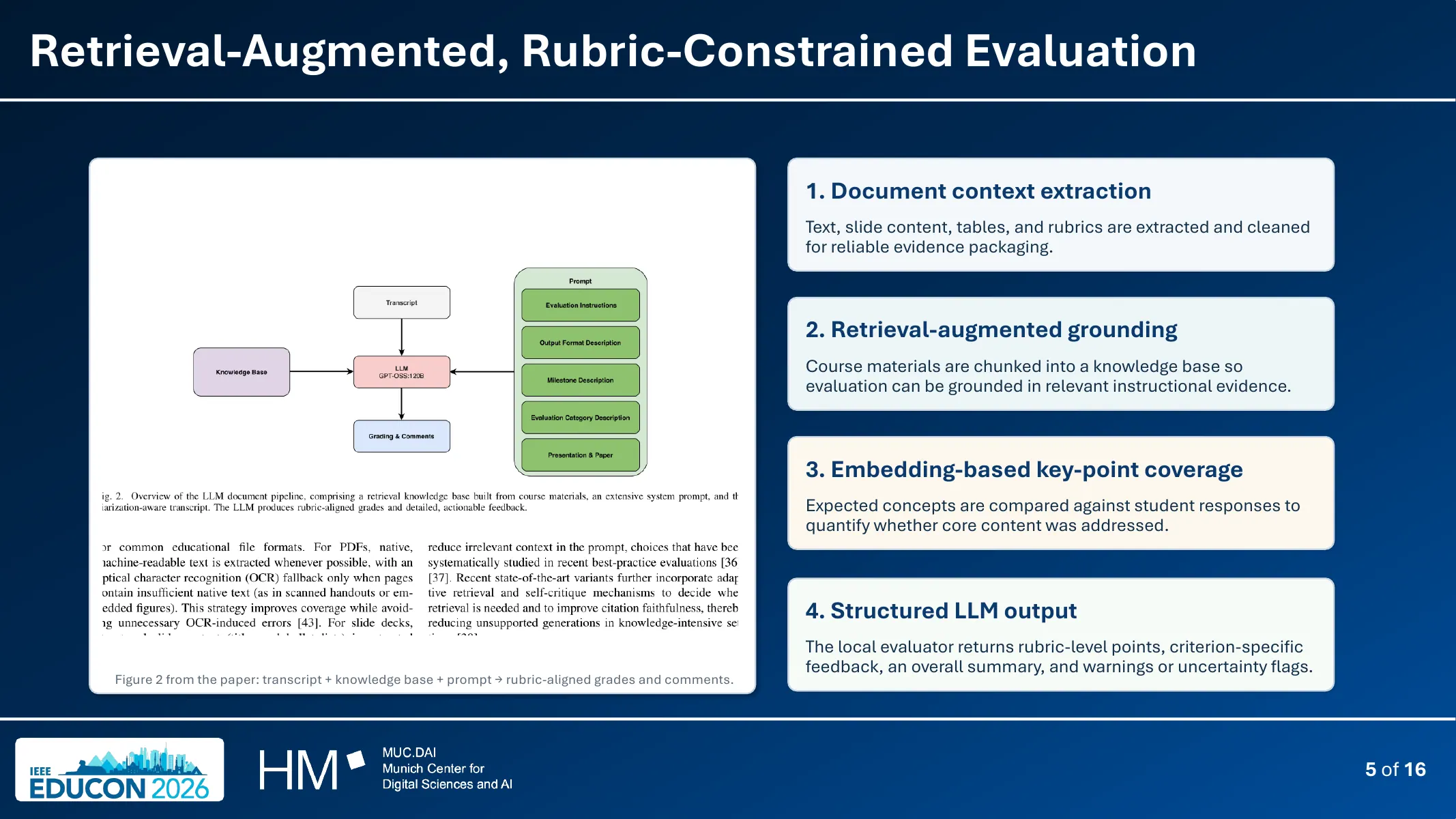
A locally hosted workflow combining audio standardization, diarization, aligned speech recognition, retrieval and language-model analysis.
Experience / System
The outcome and the infrastructure remain part of the same project truth.

What people see and feel
Evidence for examiners
A readable report connects observations to speaker-attributed transcripts, course material and assessment criteria.
Direction remains visible at every stage.
Human responsibility
- Provide rubric and course context
- Review every observation
- Accept, revise or reject suggestions
- Make the final assessment
Technical responsibility
- Enhance audio
- Identify speakers
- Align transcripts
- Retrieve relevant knowledge
- Generate bounded observations
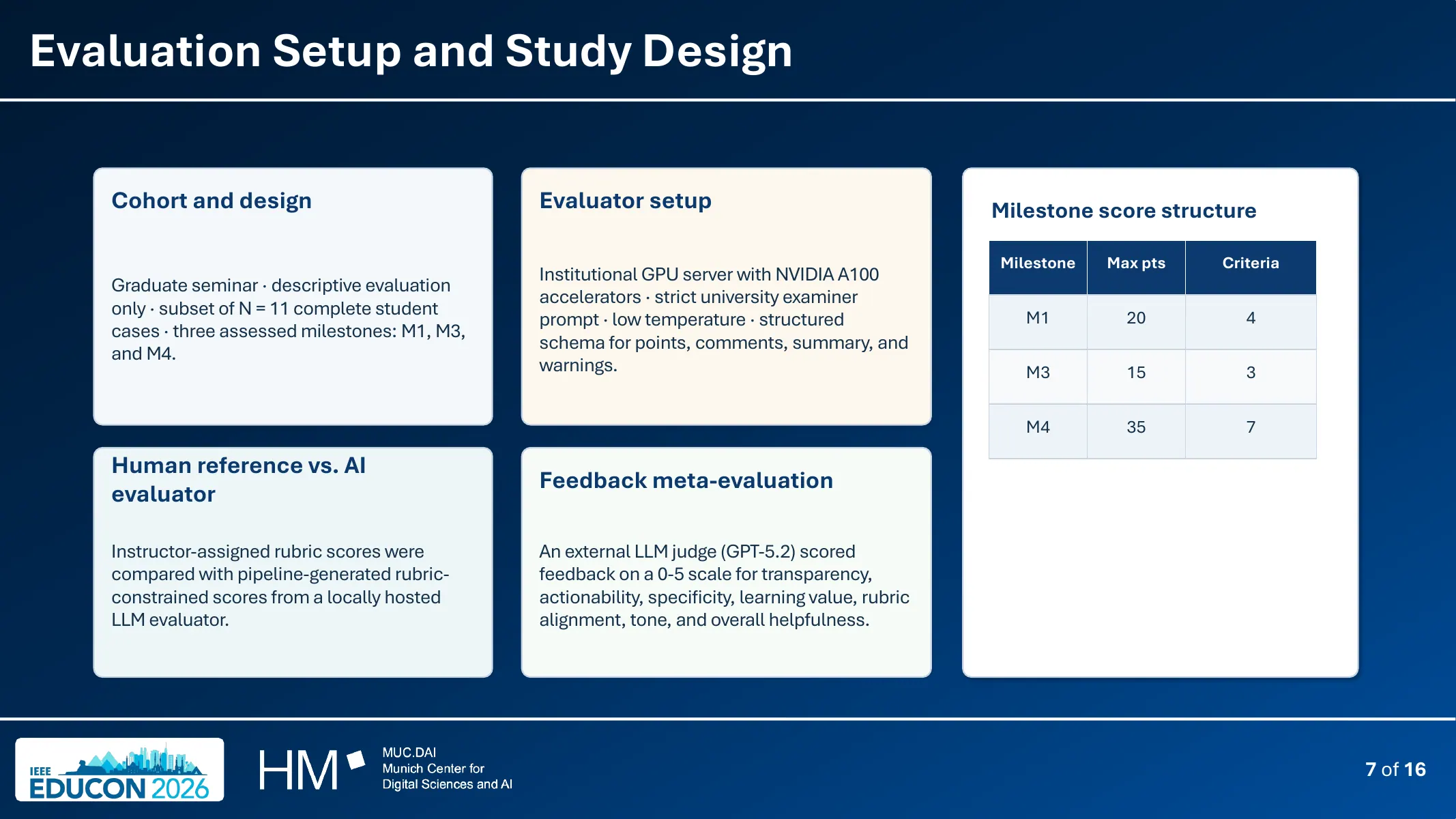
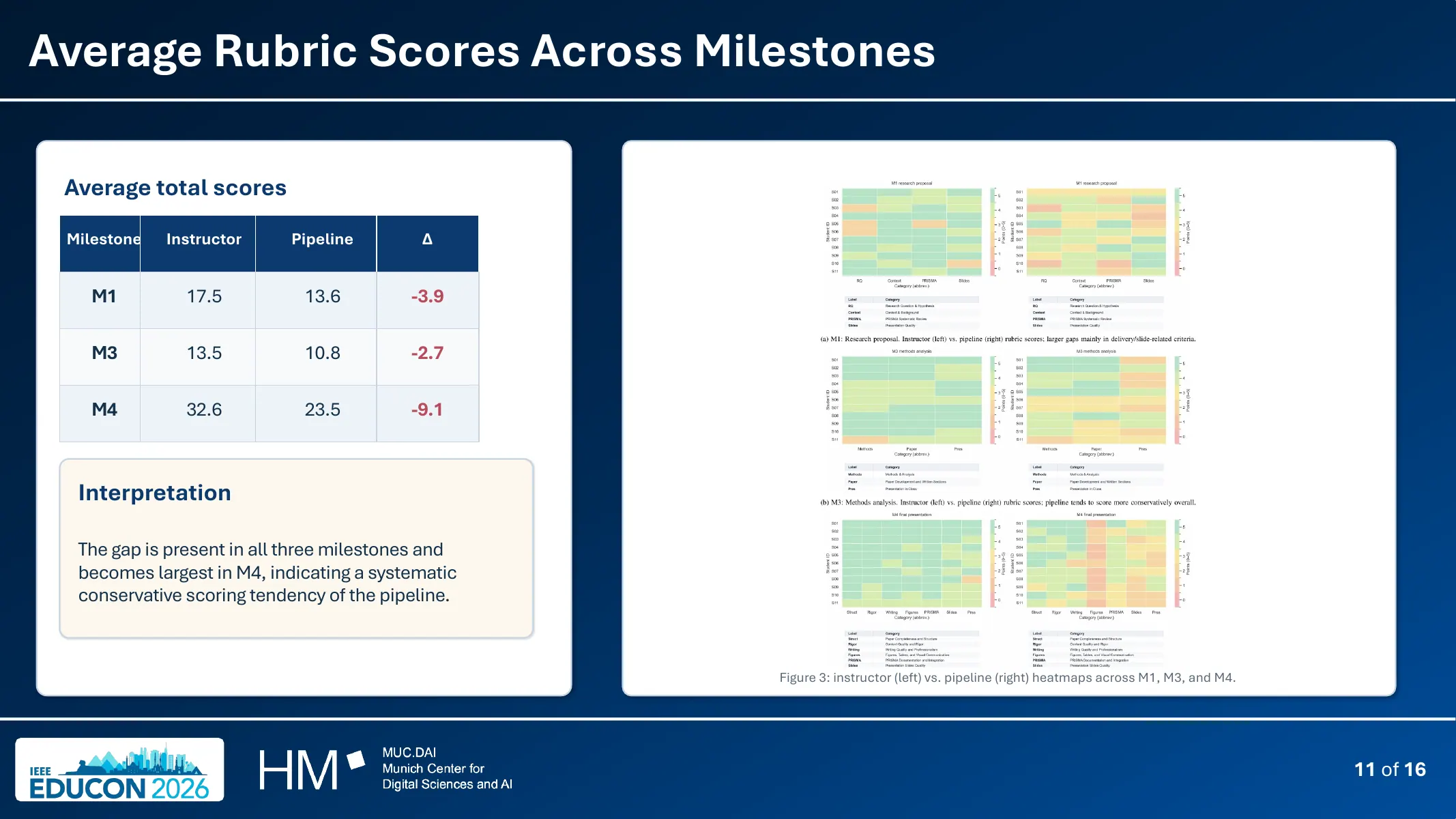
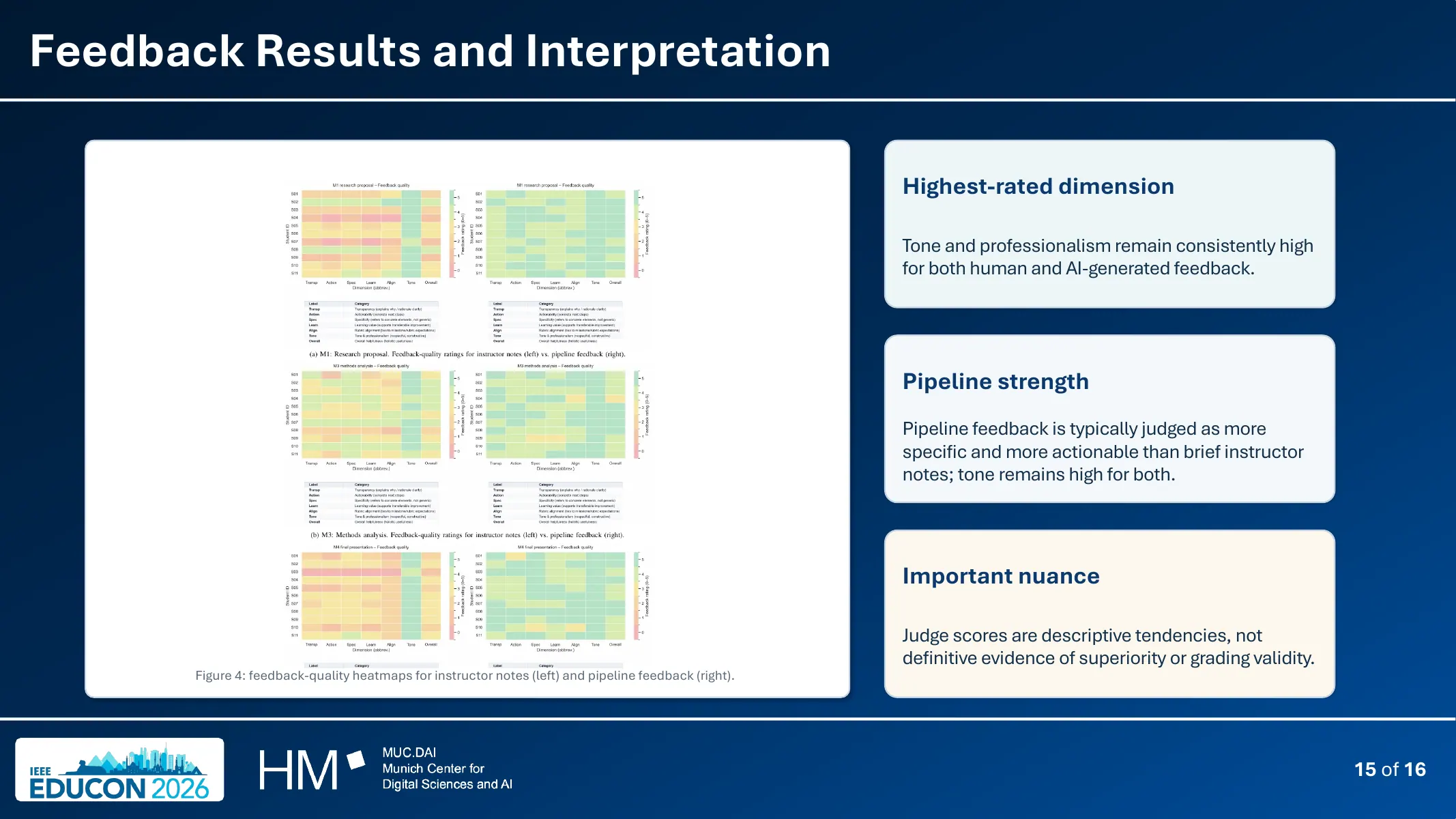
An initial evaluation compared instructor assessments with the framework across eleven complete student cases and three project milestones; high-stakes use still requires calibration, bias monitoring and explicit oversight.
All components operate inside institutional infrastructure.
A privacy-preserving, traceable assessment-support environment that can be calibrated for institutional practice.
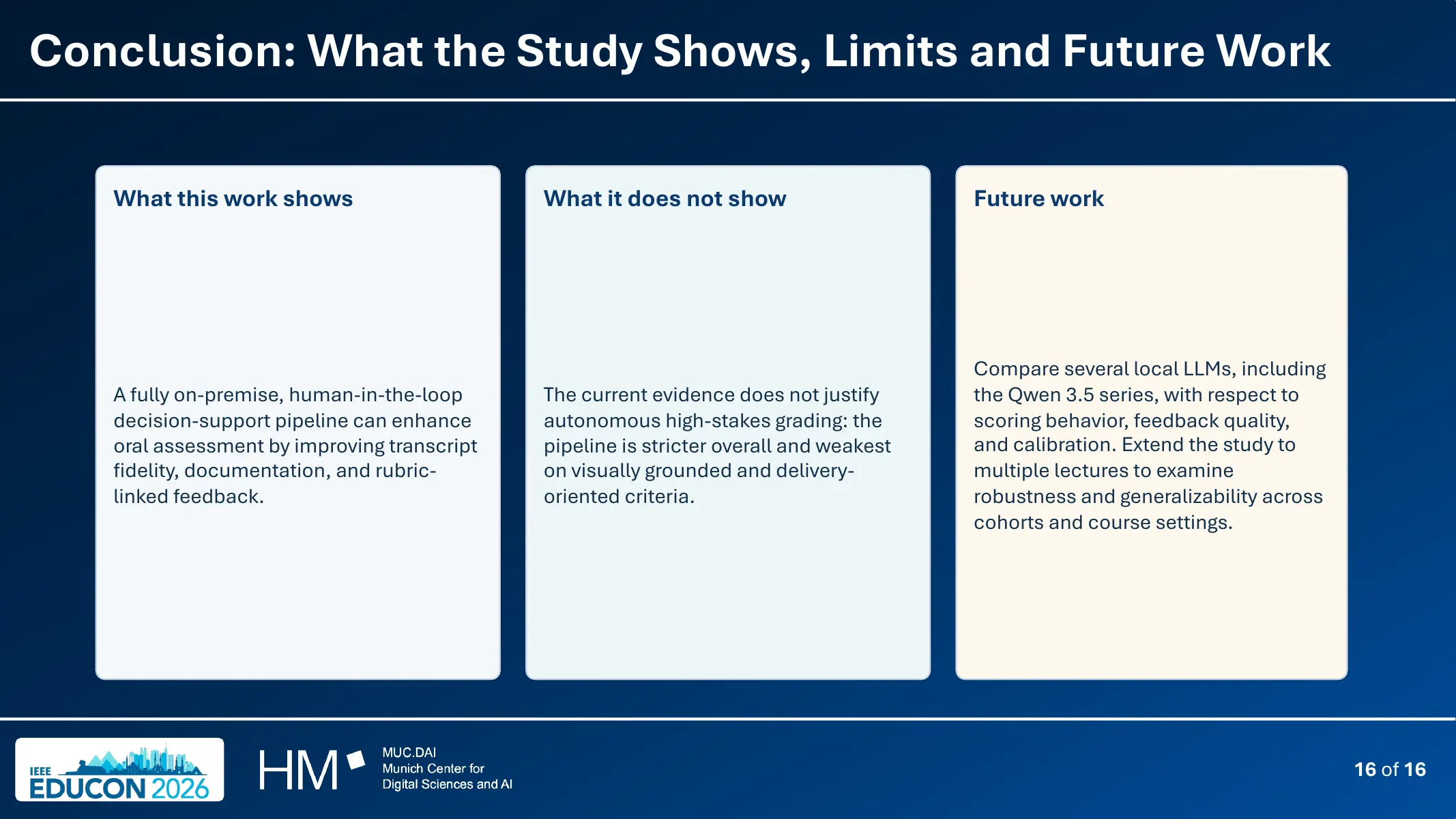
Research becomes useful when limitations, evidence, local deployment and the human decision boundary are designed into the system.
Claims carry their context.
The research was published and presented at the 2026 IEEE Global Engineering Education Conference, EDUCON, in Cairo.
Extend multimodal understanding and evaluation while preserving examiner authority.
Continue through the system.

KI-Werkstatt
Knowledge Becomes an Experience.
Experience
Learning the Invisible
Where Mathematics Becomes Motion.
Experience
The Craft of the Future
Where Ideas Become Systems.
Experience