

Opportunity Intelligence
From Signal to Conversation.
Turn market signals into relevant conversations.
- FTL role
- Strategy, agentic workflow design, AI engineering, product design, infrastructure, validation and internal operation
- Domain
- Internal Systems & Business Development
- Format
- Agentic workflow · Opportunity intelligence platform · Internal operating system
- Credits
- Designed, engineered and operated internally by Faster Than Light.


- 01
Context
FTL’s best new partnerships often announce themselves indirectly: a company hires for a capability, builds a new team or publishes a role that reveals a strategic goal. Tracking those signals manually across the DACH region meant that useful context arrived late and fragmented.
- 02
Creative vision
Build an internal intelligence system that recognizes motion before it becomes a brief. Every qualified signal should become a sourced understanding of the company, a credible FTL contribution and a conversation with a specific reason to begin.
- 03
Challenge & constraints
Public job data is noisy and temporary. Companies describe similar needs in different language, while research, contact data and portfolio evidence carry different trust and privacy boundaries. The workflow had to automate repetitive investigation without automating FTL’s judgment.
- 04
What was made
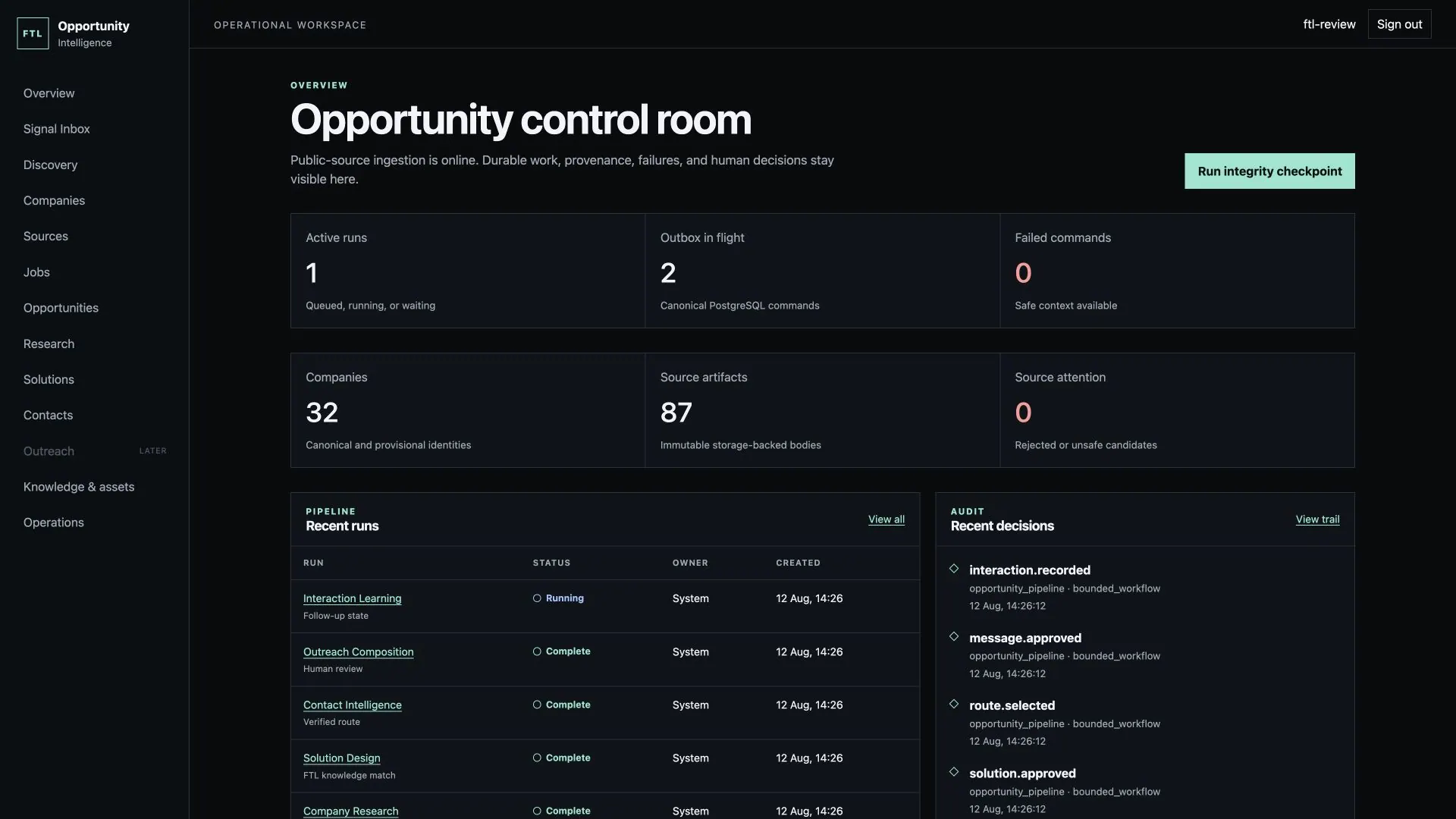
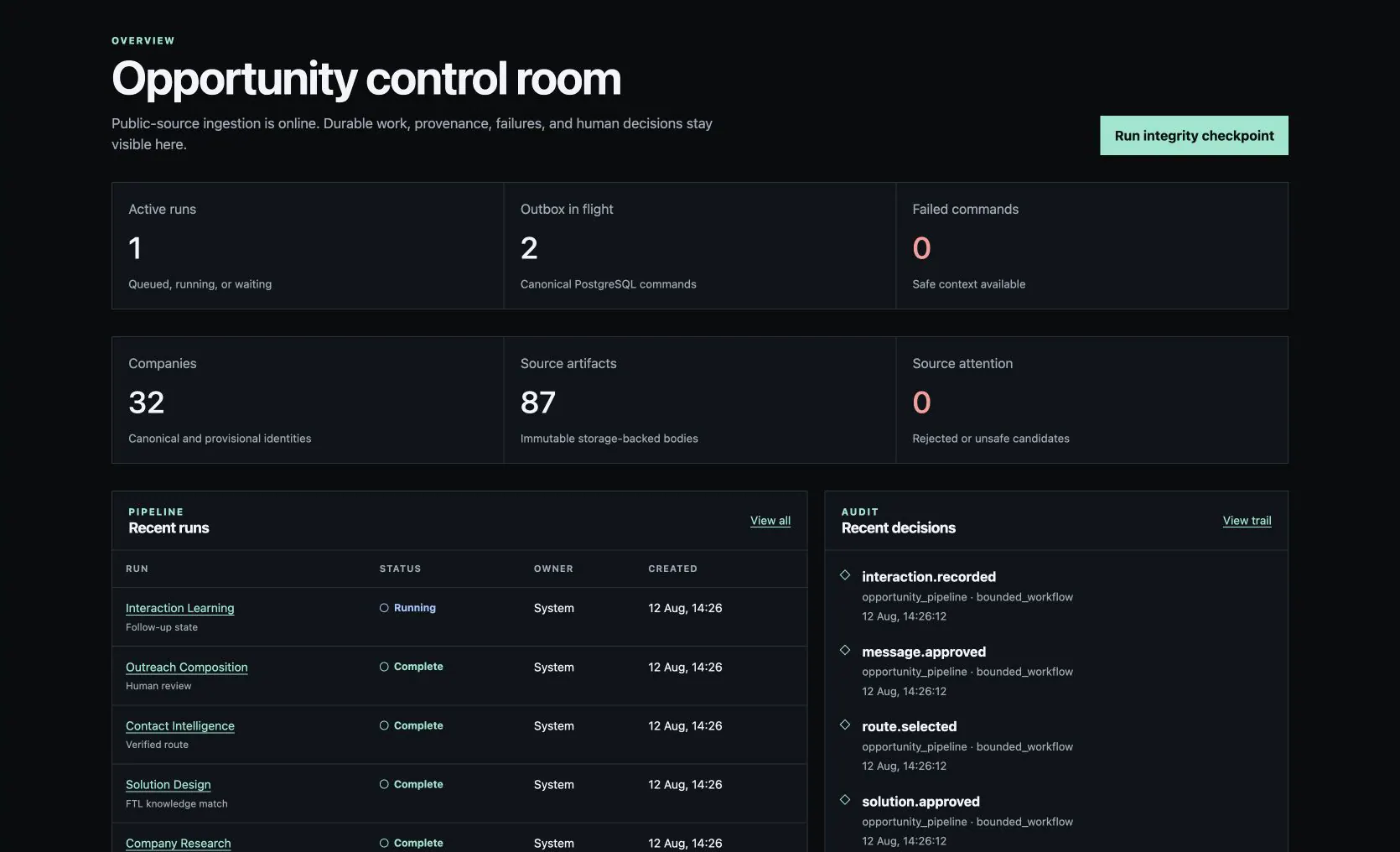
A private operational dashboard where FTL sees new positions, company profiles, supporting evidence, opportunity priority, research, solution hypotheses, matched assets, contact routes, draft status and interaction history as one traceable record.
- 05
What was built
A scheduled agentic pipeline that discovers DACH roles, normalizes and filters positions, researches each relevant company, designs an evidence-bound response, matches approved FTL work, identifies a legitimate contact route and prepares the final outreach for exact human approval, sending and tracking.
Experience / System
The outcome and the infrastructure remain part of the same project truth.

What people see and feel
A market in motion
The dashboard turns scattered public activity into a living field of companies, positions and capability signals that FTL can inspect each morning.
The reason is visible
Every opportunity explains which position created the signal, what the company appears to be building and why a specific FTL capability could matter.
One decision surface
Research, solution direction, matched work, contact route, message state and interaction history remain connected instead of disappearing across tabs and documents.
Direction remains visible at every stage.
Human responsibility
- Define the target region, strategic goals and capability vocabulary
- Approve FTL knowledge releases, claims and externally usable assets
- Review qualification, evidence and the proposed contribution
- Select the legitimate contact route and approve the exact message
- Own the relationship and interpret replies
Technical responsibility
- Run daily discovery and monitor known job sources
- Normalize, deduplicate and filter positions against relevant capability signals
- Build cited company dossiers and decomposable opportunity scores
- Design solution hypotheses and match zero to two eligible FTL assets
- Draft the evidence-bound message, send it after approval and record the interaction
Every company fact and position claim remains linked to a public source. Filters and scores are deterministic, public research is separated from private FTL knowledge, confidential or stale assets are excluded before matching, contact routes are never guessed, and suppression and approval are checked again before sending. A model cannot qualify, approve or send on its own.
The system runs inside FTL’s private operational environment. Discovery starts every morning on a Europe/Berlin schedule; the team reviews the qualified paths, authorizes the exact message, and the platform sends and records the approved interaction.
The reusable outcome is not a lead list or generic CRM template. It is an architecture for turning an organization’s own signals, knowledge, assets, rules and human decisions into a governed operating system.
Agentic workflows become valuable when they begin with a real operating need and remain observable enough for a team to understand, challenge, govern and extend.
A market signal becomes a meaningful conversation.
Seven bounded stages connect public evidence, private FTL knowledge and human authority. Every handoff, decision and correction remains visible.
01Observe
- Input
- Reviewed search definitions, public job sources, region and capability criteria
- Output
- Immutable new or materially changed job records
- Human
- Defines the target market and capability vocabulary
- System
- Searches DACH each morning, watches known endpoints, and normalizes and deduplicates positions
- Decision
- Is the source public, safe and new or materially changed?
- Correction
- Reject unsafe sources, retry failed retrievals and preserve prior valid state
02Qualify
- Input
- Normalized position snapshots and exact evidence
- Output
- Ranked opportunity signals
- Human
- Defines relevance and commercial thresholds and may override a decision with a recorded reason
- System
- Extracts source-bound capability evidence, filters matching positions and computes decomposable scores
- Decision
- Does the position reveal a relevant capability need?
- Correction
- Retract false positives or re-run classification under a newer policy
03Research
- Input
- Qualified company, position and supporting evidence
- Output
- Cited company dossier
- Human
- Authorizes research and reviews strategic context
- System
- Reads official company pages and bounded public sources, registers citations and assembles structured claims
- Decision
- Is every relevant fact current and source-bound?
- Correction
- Preserve unknowns instead of guessing and refresh stale research
04Design the Fit
- Input
- Company dossier, position goal and active FTL knowledge release
- Output
- Solution hypothesis and zero to two matched assets
- Human
- Curates offers, claims and assets and approves the proposed contribution
- System
- Connects the company’s direction to an FTL response and excludes confidential, stale or unapproved material before matching
- Decision
- Is the proposed contribution credible, useful and supported?
- Correction
- Revise the solution or return a valid zero-asset result
05Find the Route
- Input
- Approved solution and registered company sources
- Output
- Buyer-role hypothesis and eligible public contact route
- Human
- Reviews outreach eligibility and legal status and selects the exact route
- System
- Infers relevant role categories and extracts only explicitly published routes
- Decision
- Is the route legitimate, current, unsuppressed and permitted?
- Correction
- Never guess an address; a complete no-route result remains valid
06Compose
- Input
- Immutable opportunity packet containing approved evidence, solution, route, claims and assets
- Output
- Structured subject, body and short-message units with exact bindings
- Human
- Sets the communication goal and tone and edits, accepts or rejects the result
- System
- Drafts from the position, company information, company direction and approved FTL material, then checks factual and tonal consistency
- Decision
- Is every claim supported and is the message specific to this opportunity?
- Correction
- Return individual content units to drafting or evidence review
07Send & Learn
- Input
- Human-approved exact message version and selected route
- Output
- Recorded outbound interaction and follow-up state
- Human
- Authorizes the exact recipient, route and rendered message
- System
- Rechecks suppression and version hashes, sends the approved message and records the interaction
- Decision
- Is this still the exact approved and eligible version?
- Correction
- Block stale or changed inputs and preserve the complete audit trail
Opportunity Intelligence
Claims carry their context.
FTL uses the internal workspace to connect scheduled discovery, company profiling, source-bound research, solution and asset matching, contact routing, exact-version approval, dispatch and interaction history in one observable pipeline.
The same pattern can be transferred into client-specific research, partner scouting, business development, innovation, content or internal knowledge workflows—adapted to their sources, controls and teams.
Continue through the system.

KI-Werkstatt
Knowledge Becomes an Experience.
Experience
Beyond Note-Taking
Spoken Knowledge, Made Visible.
Experience
The Craft of the Future
Where Ideas Become Systems.
Experience